Digital Engagement Platforms for Pharma: Best Practices for In-Clinic Recall Campaigns
Pharma communication inside clinics is changing. For years, recall depended heavily on rep visits, printed leave-behinds, visual aids, brand reminders, and occasional doctor-facing activities. These methods still have value, but today the healthcare environment demands something more continuous, more patient-facing, and more integrated into the real clinic journey.
Doctors are busier. Consultation windows are shorter. Waiting areas are more crowded. Patients are more informed, but often misinformed. Brand managers are under pressure to show stronger recall, better engagement quality, and meaningful visibility at the point where patient conversations and treatment decisions actually happen.
This is why digital engagement platforms have become increasingly important in pharma marketing. More specifically, in-clinic digital platforms are now emerging as one of the most practical and scalable ways to build recall in a credible healthcare environment.
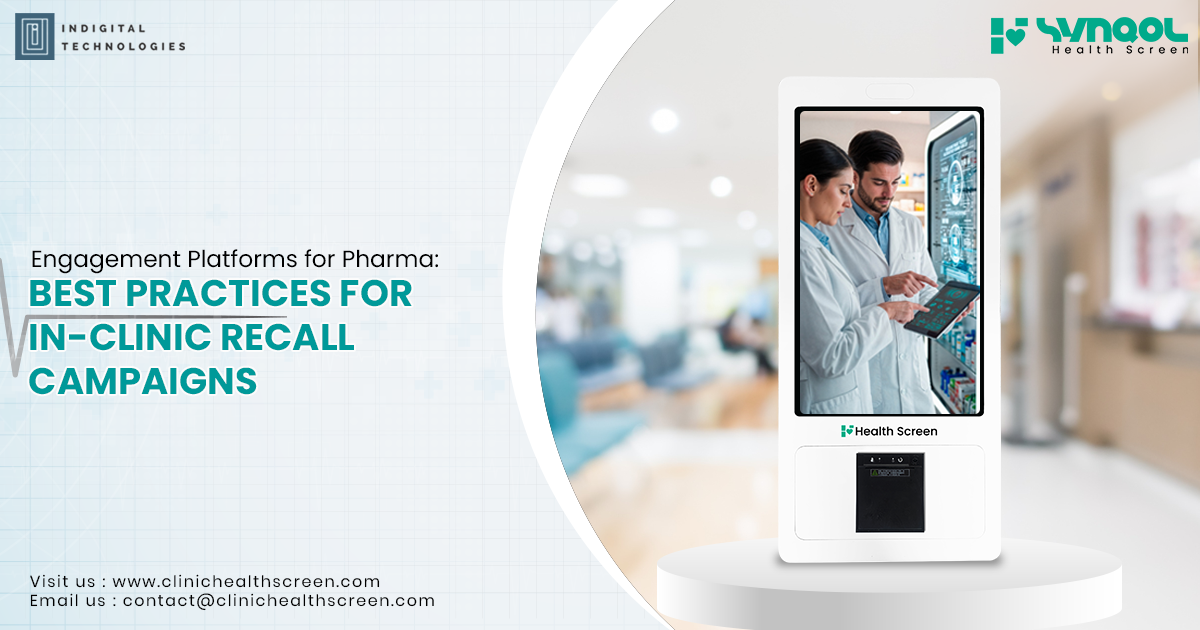
Among these, Health Screen from Indigital Technologies stands out as a powerful in-clinic patient engagement and brand communication platform designed to transform waiting areas into meaningful awareness zones. For healthcare professionals and doctors, it supports patient education and consultation readiness. For pharma teams, it creates repeated, compliant, high-visibility brand recall in a real-world clinical setting.
This article explores the best practices for in-clinic recall campaigns and explains why digital engagement platforms such as Health Screen by Indigital Technologies are becoming essential for modern pharma outreach.
Why in-clinic recall matters more than ever
In-clinic recall is valuable because it happens at a highly relevant moment. A patient is already thinking about their symptoms, diagnosis, treatment, or next step. A caregiver is attentive. The doctor is about to consult or has just consulted. This is a context where health messaging is not random interruption; it is highly aligned with patient intent.
That is what makes clinic-based communication more powerful than broad, generic awareness in many therapy areas.
For pharma, recall is strongest when the message is:
- seen repeatedly
- delivered in a relevant setting
- easy to understand
- connected to patient concerns
- supportive of doctor-patient dialogue
- credible rather than overly promotional
Traditional materials often struggle to deliver all of this consistently. A poster may remain unnoticed. A leaflet may be ignored. A rep visit may be brief. But a dynamic digital platform in the waiting area can deliver repeated, well-timed, visually engaging communication throughout the clinic day.
This is where Health Screen from Indigital Technologies becomes highly effective. It allows pharma brands to remain visible in clinics through rotating disease awareness content, brand communication, clinic information, health education visuals, and even risk screening modules that make waiting time more meaningful.
The shift from passive visibility to active engagement
The old model of clinic branding was largely passive. A standee stood in the corner. A poster hung on a wall. A branded item stayed on a table. These materials could build some presence, but they did not truly engage the patient.
Digital engagement changes that. It moves the communication from static display to active participation.
A strong in-clinic digital engagement platform can:
- attract attention through movement and changing visuals
- educate patients using short, simple, understandable content
- reinforce key health messages repeatedly
- support condition awareness before consultation
- reduce confusion and improve question quality
- give the brand a more helpful and modern role in the clinic
For healthcare professionals, this is important because it can make the waiting area more useful. Instead of patients sitting passively or scrolling through unrelated content, they encounter health information relevant to their visit.
For pharma marketers, it means that recall is no longer dependent only on frequency of rep presence. The clinic itself becomes an always-on communication point.
Why recall campaigns fail inside clinics
Many in-clinic campaigns fail not because the medium is wrong, but because the approach is weak. Common mistakes include:
1. Over-branding without enough value
If the content feels too promotional and not informative enough, patients ignore it and doctors may not appreciate it.
2. Too much medical complexity
Waiting area content must be simple. It should educate, not overwhelm.
3. Generic messaging across all clinics
A gynecology clinic, orthopedics clinic, diabetes center, and fertility clinic need different communication strategies.
4. No continuity
A one-time install without content refresh quickly becomes invisible.
5. No link to patient journey
Content should reflect what patients are likely thinking, fearing, or asking at that stage.
6. No doctor relevance
If the platform does not help improve the consultation experience in some way, long-term acceptance may weaken.
The best in-clinic recall campaigns avoid these mistakes by being patient-aware, therapy-specific, visually strong, and clinically supportive.
What makes a digital engagement platform effective for pharma
Not every screen in a clinic becomes a strong recall medium. For a platform to truly work, it must combine communication value with clinic practicality.
An effective digital engagement platform should offer:
Continuous in-clinic visibility
The brand should remain present even when no rep is in the clinic.
Therapy-specific content
The content should reflect the therapy, patient concerns, and common consultation themes of that specialty.
Patient-friendly format
Short videos, myth-versus-fact messages, awareness visuals, and screening modules work better than dense text.
Support for clinic workflow
The platform should fit naturally into the clinic setup and not create extra burden for the doctor.
Repeat exposure
One of the biggest strengths of digital recall is repeated exposure. Patients see the same brand and message multiple times across waiting and counselling phases.
Credible educational value
Recall improves when the patient feels the brand is associated with useful information rather than mere advertising.
This is why Health Screen by Indigital Technologies has strong relevance. It is not just a display device. It is a smart clinic engagement platform that can educate patients, support waiting area awareness, showcase clinic and doctor information, and deliver repeated brand messaging in a more integrated and credible manner.
Health Screen from Indigital Technologies: a direct fit for in-clinic recall
Health Screen by Indigital Technologies is designed specifically for clinics and healthcare environments. It turns waiting areas into active patient engagement spaces by combining:
- health awareness content
- disease education videos
- brand messaging
- clinic service information
- doctor profile display
- patient screening and risk-assessment tools
- queue or token support in many use cases
This matters because recall is stronger when the patient associates the message with something useful and relevant.
Instead of acting like a passive media surface, Health Screen becomes part of the clinic experience. Patients learn while they wait. Doctors receive patients who are more primed for discussion. Brands gain repeated, high-frequency exposure in a setting where healthcare attention is already elevated.
For healthcare professionals, this means better informed patients and more meaningful pre-consultation conditioning. For pharma teams, it means brand visibility that works every day, not only during rep presence.
Best practice 1: lead with patient problems, not brand claims
The strongest in-clinic recall campaigns begin with what the patient is already feeling.
For example:
- In cardiology: silent risk, blood pressure control, missed symptoms
- In gynecology: irregular periods, screening awareness, myths around hormones
- In diabetes: sugar control, neuropathy, diet confusion, adherence
- In orthopedics: pain progression, mobility decline, early consultation
- In IVF/fertility: stress, myths, timelines, expectations
When content starts with the patient’s real concern, attention rises immediately. Once attention is captured, the communication can guide the patient toward awareness, doctor discussion, or therapy understanding.
Health Screen works especially well here because it allows short, therapy-relevant patient awareness content to run in loop form. That repeated visibility supports both education and recall.
Best practice 2: keep content short, visual, and repetitive
The clinic waiting area is not the place for long-form teaching. It is the place for short, memorable reinforcement.
The best content types for in-clinic recall include:
- 15–30 second awareness reels
- short explainer videos
- myth-versus-fact cards
- symptom awareness slides
- screening prompts
- risk-check messages
- treatment continuity reminders
- lifestyle care visuals
Repetition matters. A message seen once may be forgotten. A message seen several times across different visits becomes recall.
This is one of the biggest advantages of Health Screen from Indigital Technologies. Because it runs continuously in the clinic, it can deliver the same core therapy and brand messages repeatedly in a non-intrusive way. This creates stronger memory retention over time.
Best practice 3: adapt the campaign to the specialty
A one-size-fits-all campaign is rarely effective. In-clinic recall should reflect specialty-specific needs.
In gynecology
Content may focus on menstrual health, PCOS, fibroids, preventive screening, menopause, fertility, or myths around hormonal treatment.
In diabetes
Content may highlight foot care, eye checks, complications, lifestyle management, and adherence.
In orthopedics
Pain progression, posture, arthritis, joint mobility, and early intervention work well.
In fertility/IVF
Step-by-step treatment understanding, emotional reassurance, timelines, and expectation management are key.
In pulmonology
Inhaler use, symptoms, triggers, and adherence are highly relevant.
Health Screen is suitable for this because the platform supports specialized content modules for different therapy areas. That makes it easier for brand managers to create clinic-relevant recall instead of generic messaging.
Best practice 4: use education to improve doctor acceptance
Doctors are more likely to value a digital platform if it supports patient readiness rather than simply pushing brand presence.
A recall campaign becomes more acceptable when it helps:
- prepare patients before consultation
- reduce repeated misconceptions
- support lifestyle counselling
- encourage the right questions
- improve understanding of risk or screening
This is why educational value is not just a nice extra; it is central to long-term in-clinic adoption.
Health Screen from Indigital Technologies supports this balance effectively. It gives brands presence, but does so through patient education, awareness content, and practical waiting-area utility. That makes the platform more credible in the eyes of healthcare professionals.
Best practice 5: connect recall to real clinic workflow
The most effective digital platforms do not sit apart from the clinic. They become part of it.
A waiting-area screen should align with the actual patient flow:
- patient arrives
- patient waits
- patient watches awareness content
- patient becomes more curious or informed
- patient enters consultation
- doctor conversation becomes more meaningful
That sequence is powerful because it improves the quality of engagement before the doctor even begins speaking.
In many settings, Health Screen also supports queue display or token workflow. This adds utility to the device, which can increase visibility, acceptance, and continuous patient attention.
Best practice 6: make the brand part of a credible care environment
Brand managers today must think beyond logo presence. The more useful and contextually relevant the communication feels, the stronger the brand’s reputation becomes.
A strong in-clinic recall campaign should position the brand as:
- supportive of awareness
- aligned with better patient education
- present in a care environment
- helping doctors communicate better
- committed to continuity, prevention, or adherence
This shift is essential. Patients and doctors respond better to brands that appear to add value, not just visibility.
Health Screen helps make this possible. It places the brand inside a credible, doctor-supervised, patient-focused environment where awareness and engagement naturally belong.
Best practice 7: refresh content regularly
One major risk in clinic media is fatigue. If patients and staff see the exact same thing endlessly, attention drops.
The solution is periodic refresh:
- new awareness themes
- seasonal messaging
- updated educational reels
- health-day alignment
- myth-versus-fact rotation
- screening campaigns
- adherence reminders
Health Screen’s digital format makes this much easier than printed materials. Content can evolve over time without replacing physical installations. This is a major operational advantage for pharma marketers who want long-term recall value.
Best practice 8: measure value beyond impressions
In a clinic environment, success should not be judged only by how many people saw the screen. More meaningful indicators include:
- doctor acceptance
- patient engagement quality
- improved consultation readiness
- stronger brand recall
- increased therapy awareness
- better waiting-area experience
- support for screening or adherence prompts
For HCPs and doctors, the strongest proof of value is often qualitative: patients arrive more informed, ask better questions, and need less basic explanation. For pharma teams, this translates into stronger, more credible point-of-care recall.
Why HCPs and doctors should care
Healthcare professionals often see patient confusion firsthand. Many patients arrive late, misunderstand symptoms, ignore screening, fear treatment, or discontinue therapy once they feel a little better.
A platform like Health Screen from Indigital Technologies helps address this challenge before consultation begins. It supports awareness while patients wait, making them more prepared and more receptive to structured doctor guidance.
For doctors, this can mean:
- less time spent correcting basic misconceptions
- more productive consultation time
- better patient understanding
- smoother counselling
- stronger support for adherence and follow-up
That is why in-clinic digital engagement is not only a pharma tool. It is also a clinical communication tool.
The future of recall is smarter, not louder
The future of pharma communication in clinics will not belong to the loudest message. It will belong to the most useful one. In an environment where doctors are busy and patients are overwhelmed, the brand that helps improve understanding will be remembered better.
Digital engagement platforms are important because they create that opportunity at scale. They allow clinics to become education spaces, not just waiting spaces. They allow brands to be continuously visible without being disruptive. And they allow healthcare professionals to receive patients who are more primed for meaningful care conversations.
That is exactly why Health Screen by Indigital Technologies is such a valuable platform. It combines patient education, waiting-area engagement, clinic utility, and brand recall in one solution. It directly supports the real moment where healthcare awareness and treatment communication intersect.
Conclusion
Digital engagement platforms are no longer optional for pharma teams looking to build strong in-clinic recall. They are becoming central to how awareness, brand visibility, and patient education come together inside clinics.
For healthcare professionals and doctors, the best platform is one that improves patient understanding without creating more effort. For brand managers, the best platform is one that keeps the brand visible in a credible, useful, and repeated way.
Health Screen from Indigital Technologies delivers exactly this balance. It transforms waiting areas into communication spaces, helps patients become more aware before consultation, supports better clinic engagement, and gives pharma brands a smarter way to build recall where it matters most.
In-clinic recall campaigns work best when they are relevant, visual, repeated, and genuinely helpful. When done right, they do more than build memory. They improve the quality of healthcare communication itself.
And that is where digital engagement stops being just marketing—and starts becoming real clinical value.